Updated: July 2026
Phinisi Yacht Charter Atelier — Handcrafted Bugis Voyages Komodo Raja Ampat
Phinisi Yacht Charter is a curated Indonesia luxury tourism experience offered by Phinisi Yacht Charter Atelier: handpicked routes, vetted operators, transparent pricing, and 24/7 concierge support across Indonesia.
- What makes Phinisi Yacht Charter a premium experience.
- How Phinisi Yacht Charter Atelier curates exclusive access and concierge logistics.
- Routes, seasons, and pricing transparency — no hidden fees.
Phinisi Yacht Charter Atelier
Handcrafted Bugis voyages across the Indonesian archipelago. Curated traditional phinisi schooner charters through Komodo, Raja Ampat, Wakatobi, Bali, and the Banda Sea — built by hand in Bira, Sulawesi.
A phinisi yacht charter is a voyage on a working piece of Bugis maritime heritage
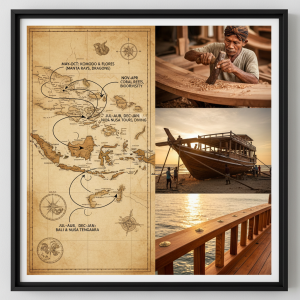
A phinisi yacht charter places a private group aboard a hand-built Indonesian schooner — a twin-mast, gaff-rigged vessel shaped from teakwood and ironwood by Bugis-Makassarese shipwrights at the Bira and Bulukumba shipyards of South Sulawesi. The pinisi (also written phinisi) is a craft so culturally significant that UNESCO inscribed pinisi shipbuilding on the Representative List of the Intangible Cultural Heritage of Humanity in 2017. When you charter one of these schooners through Komodo National Park, the Raja Ampat archipelago, Wakatobi, Bali day-sails, or the remote Banda Sea, you are stepping onto a living maritime tradition that has been refined across seven generations of Konjo shipwrights — yet outfitted to modern luxury standards with air-conditioned cabins, marine ensuites, dive compressors, professional chef, and a crew of eight to twelve.
Phinisi Yacht Charter Atelier is an independent charter curator. We do not own a single hull. Instead, we maintain working relationships with twelve to fifteen of the finest hand-built phinisi presently sailing Indonesian waters, and we match guests to vessels and itineraries based on the way they actually want to travel — not the boat that happens to be available. The atelier model means a single conversation with us replaces twenty conversations with individual vessel operators. We hold direct booking lines with the vessels themselves, we know which captains run dry boats and which have a heavier cocktail hour, we know which chefs can handle a kosher table or a coeliac guest or a crew of vegan freedivers, we know which vessels carry the right tenders for a freediving expedition versus a slow gastronomy cruise, and we know which routes time well against the manta plankton bloom or the mola mola season.
The vessels themselves reward close attention. Hull seams reveal the joinery technique that Konjo shipwrights call papan tindih, where each plank overlaps the one below in a graduated lap that gives the hull its characteristic curved profile. Masts rise from below deck through reinforced ironwood collars. Rigging is hand-spliced. The steering wheel is solid teak, often inlaid with brass and abalone. Iron nails are forged at the foot of Tana Toraja and driven by hand. Below deck the contemporary fit-out — climate-controlled cabins with rain-shower ensuites, marine-grade linens, generous port windows — settles softly inside the heritage structure. The result is a vessel that reads as luxurious without ever feeling artificial. The teak and ironwood are real. The rigging is alive. The boat works the wind.
Why travellers choose a phinisi over a modern motor yacht
Heritage authenticity
A phinisi is not a replica. The hull is hand-shaped ironwood and teakwood, carved by Konjo shipwrights in Tana Beru, Bira, and Bulukumba using methods refined across seven generations. You are sleeping inside a UNESCO-listed living craft.
Single-group privacy
Every charter is a single-group private hire. You will not share the vessel with another party at any point. The deck, the salon, the dive deck, the upper sundeck — all yours for the entire voyage.
Sailing pace
Phinisi cruise the archipelago at 7-9 knots under sail and engine. The pace is slow, deliberate, and synchronised to wind and tide. You move through the water the way Bugis traders did for four hundred years.
Crew of twelve
A typical phinisi crew runs eight to twelve, including captain, two engineers, chef, sous chef, dive guide, two cabin crew, and deckhands. The guest-to-crew ratio is rarely below 1:1, often better.
Five charter destinations across the Indonesian archipelago
A phinisi charter is defined as much by the route as by the vessel. We curate voyages across five primary cruising grounds, each with its own season, character, and reason to sail.
Komodo National Park (the popular choice)
A 4-7 day voyage from Labuan Bajo on Flores covers Padar Island’s three-bay viewpoint, the rose-coloured sand of Pink Beach, the dragon-trekking trails of Rinca and Komodo, the manta cleaning stations of Manta Point and Mawan, and the warm-water reefs around Sebayur and Siaba. Komodo is the most accessible phinisi route and runs reliably from April through November. Read our comparison of Komodo, Raja Ampat, and Bali charters for help choosing.
Raja Ampat (the premium expedition)
Raja Ampat sits at the apex of marine biodiversity on Earth — the centre of the Coral Triangle, with more than 1,500 fish species and seventy-five percent of the world’s known coral genera. A phinisi voyage here runs 8-12 days from Sorong, threading the Wayag karst islands, Misool’s lagoons, the manta gathering point at Magic Mountain, and the Dampier Strait dive sites. Premium pricing reflects the remoteness and the season — November through April for southern Raja Ampat, October through April for northern.
Wakatobi and the Tukang Besi archipelago
South-east of Sulawesi, Wakatobi sits inside a 1.4-million-hectare marine national park with reefs that rival Raja Ampat for diversity but receive a fraction of the visitors. A 7-10 day phinisi voyage here works the southern atolls, the Bajau sea-gypsy villages of Sampela, and the wall dives of Tomia. Wakatobi rewards travellers who want the biology of Raja Ampat without the schedule.
Bali day charter and 3-day inter-island
A phinisi day charter from Benoa to Nusa Penida and Nusa Lembongan delivers the cultural pleasure of a Bugis schooner without the time commitment of an overnight voyage. The 3-day Bali-Lombok inter-island trip is the natural extension — anchoring overnight at Gili Trawangan or Gili Air, snorkelling the turtle reefs at Manta Bay, and returning across the Lombok Strait under sail.
Banda Sea and Spice Islands (advanced expedition)
The Banda Sea voyage is for serious travellers — 12-14 days through the historic spice route, anchoring at the volcanic peak of Banda Api, the nutmeg plantations of Banda Naira, the hammerhead crossing at Manuk, and the remote Forgotten Islands of Damar and Romang. This is a rare route, available only October to November.
Our partner phinisi fleet — handpicked, hand-built, hand-maintained
We work with a curated network of phinisi owners and operators across Indonesia. Every vessel in our partner network has been audited for hull integrity, safety equipment, crew tenure, food hygiene, and the indefinable quality of feeling right when you step aboard. The named vessels below represent the spirit of the network — final assignment depends on availability, route, group size, and budget.
Bunga Laut
38m / 5 cabins / 10 guests. Built 2018, Bira. Master cabin with ocean-view bathtub, dive compressor on board, kompres tender for shallow-reef approach.
Sang Surya
42m / 6 cabins / 12 guests. Built 2020, Bulukumba. Twin-deck salon, full beam master with private terrace, two tenders, certified Padi dive centre on board.
Tanjung Asu
35m / 4 cabins / 8 guests. Built 2016, Tana Beru. Family-friendly layout, two convertible twin-double cabins, sun-deck jacuzzi, slow gastronomy chef on board.
Andalas
45m / 7 cabins / 14 guests. Built 2021, Bira. Largest in the network, suite-style cabins, wellness deck with massage cabana, two professional dive guides standard.
Putri Naga
36m / 5 cabins / 10 guests. Built 2019, Bira. Honeymoon-spec layout, low-density 2:1 crew-to-guest ratio, custom Bugis-batik linens, vegetarian-capable galley.
Ready to plan a phinisi voyage?
Tell us your dates, your destination interest, and your group size. We will return three vessel options within forty-eight hours, with full pricing, cabin layouts, and indicative itineraries. There is no booking fee, and our advice is impartial across the partner fleet.
Voyage planning resources
- Curated private phinisi voyage — full breakdown of vessels, routes, cabins, cost
- Phinisi yacht charter cost 2026 — pricing benchmarks per route
- Komodo vs Raja Ampat vs Bali — choosing your charter destination
- How a phinisi is built — the craft of Bira and Bulukumba
- Phinisi vs modern liveaboard — an honest comparison
- Frequently asked questions